In an age of compartmentalised knowledge and fast-paced academics, it’s easy to forget how naturally children learn. Real learning doesn’t happen in neat, isolated subject boxes – it happens when the world makes sense, when connections are drawn, and when a child is truly engaged.
That’s where integrated learning comes in. It is a fundamental principle in Waldorf education, and one that serves not only academic outcomes, but the whole development of the child – especially those with different learning styles.
Beyond Subjects in Isolation
In many conventional classrooms, children move from maths to science, then on to reading, art or PE – all taught by different teachers with little overlap between content. While this system may seem efficient, it often lacks cohesion and context, particularly for children who learn best through experience or imagination.
Waldorf education offers a different path.
In Waldorf schools, subjects are woven together into extended “main lesson” blocks that explore a topic from multiple angles – intellectually, emotionally, physically and artistically. A lesson on ancient Egypt, for example, might include:
- Mapping the geography of the Nile
- Writing in hieroglyphics
- Building pyramids with clay
- Exploring number systems through Egyptian maths
- Painting temple scenes
- Listening to or acting out stories of the gods and goddesses
This approach is not simply more engaging – it mirrors how the brain naturally learns: through connection, repetition, and multi-sensory experience.
Why It Matters for Different Learning Styles
Every child learns differently. While some thrive on lectures and textbooks, others need to move, create, hear, or feel to fully understand a concept. Integrated learning supports this diversity by offering multiple entry points into the material.
Visual Learners
Children who are drawn to shapes, colour and imagery benefit from Waldorf’s rich artistic content. Blackboards are transformed into visual stories; painting, drawing and form work become tools for understanding.
Auditory Learners
Songs, rhythmic verses and oral storytelling embed language, history and number facts in a way that resonates with auditory thinkers.
Kinaesthetic Learners
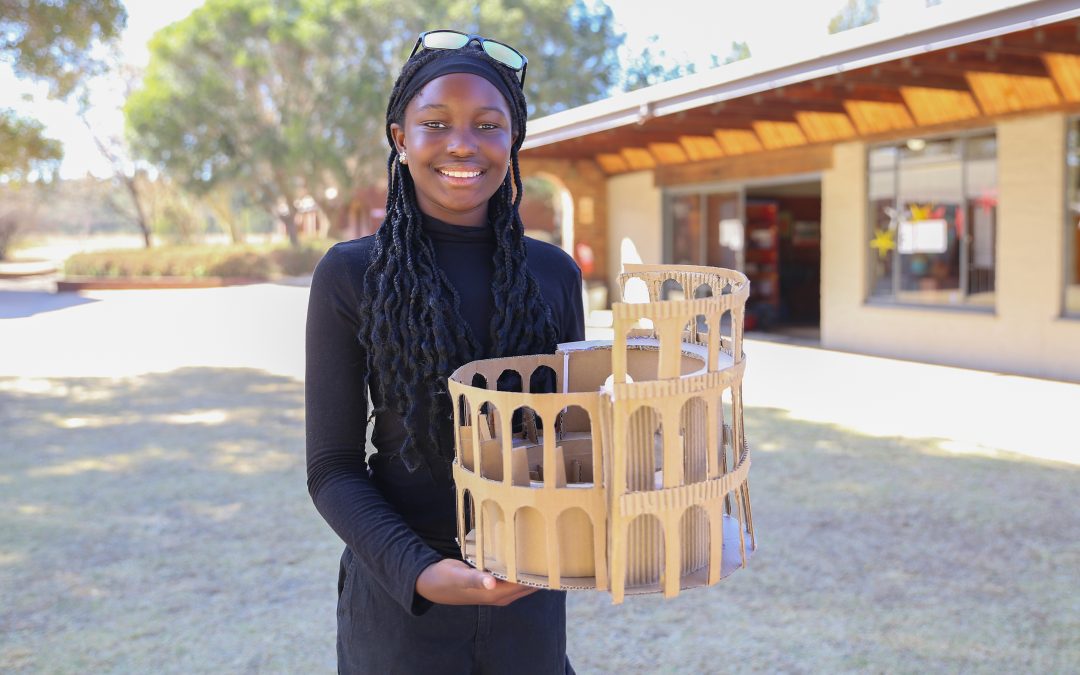
Through movement, modelling, handwork, and drama, children experience learning in their bodies. Whether they are clapping times tables or building shelters in nature, they are physically involved in learning.
Practical & Creative Thinkers
For children who may not excel in conventional test-taking or memorisation, integrated learning provides real-life relevance. Making something with their hands or telling a story through art brings purpose and motivation.
Learning That Lasts
When a child learns something in more than one way – feeling it, hearing it, doing it, creating it – they’re not just learning what to think. They’re learning how to think, how to process, and how to apply knowledge in the world around them.
Integrated learning leads to:
- Deeper understanding
- Improved memory
- Stronger problem-solving skills
- Greater engagement and curiosity
- Higher emotional and social intelligence
It also reduces the pressure to “perform” in just one narrow way, making room for true confidence to grow.
A Final Thought
Children are not machines – and education is not simply about uploading information. Real education meets the whole child, in all their complexity and uniqueness
In Waldorf education, integrated learning is more than a method. It is a reflection of how real life works. It respects the natural development of children, encourages wonder, and welcomes the wide range of human intelligence and creativity.
In a world that is increasingly fragmented and specialised, this approach offers something quietly revolutionary: coherence, meaning, and the space for every child to thrive.